


Science
Welcome
At The Cotswold School, the Science Department is driven by a shared belief that science education should inspire curiosity, develop deep understanding, and prepare students to engage critically with the world around them.
We aim to nurture inquisitive, confident learners who appreciate the power of science to explain natural phenomena, shape technological advancement, and influence global challenges. Through engaging, thoughtfully structured lessons, students are encouraged to question, analyse and apply their knowledge in meaningful contexts.
Our Intent
Our curriculum is designed to ensure that all students develop:
• A secure and increasingly sophisticated body of scientific knowledge
• The ability to think, speak and write like scientists
• A genuine sense of curiosity and intellectual independence
• An understanding of the relevance of science to everyday life and future careers
While we are proud of strong outcomes at GCSE and A Level, our ambition extends beyond examination success. We seek to cultivate a lifelong interest in science and equip students with the skills and confidence needed to thrive in further education and employment.
Curriculum Principles
Our curriculum is built around the following core principles:
• Ambition for all – a challenging curriculum that supports every student to achieve their potential
• Careful sequencing – knowledge is deliberately structured so that ideas build over time and support long-term retention
• Depth over superficial coverage – students develop secure understanding rather than simply covering content
• Thinking and communication – a strong emphasis on literacy, oracy and clear scientific explanation
• Inclusion and support – adaptive teaching ensures all learners can access and succeed in science
• Wider relevance – links to real-world applications, careers and global issues
• Cultural awareness – recognition of diverse contributions to scientific discovery
How Students Learn
We teach science as both a body of knowledge and a way of thinking.
Students are supported to:
• Recall and apply knowledge through regular retrieval practice
• Make connections between topics through deliberate curriculum sequencing
• Develop understanding through practical work and enquiry-based learning
• Reflect on and improve their learning using metacognitive strategies such as self-testing, interleaving and elaboration
Our approach is rooted in the principle that learning is most effective when it leads to lasting changes in long-term memory.
Curriculum Structure and Assessment
The curriculum is carefully sequenced from Year 7 to Year 11 (and beyond), ensuring that foundational concepts underpin more complex ideas later in the course.
Students complete termly assessments which:
• Assess both recent and prior learning
• Increase in demand over time
• Encourage revision strategies that support long-term retention
Assessment is used diagnostically to inform teaching and help students close knowledge gaps.
Homework and Independent Study
Homework is designed to reinforce and extend learning through:
• Low-stakes retrieval practice
• Structured exam-style questions
• Opportunities to revisit and improve key areas of understanding
Students are guided in how to revise effectively, developing study habits that will support success throughout their education.
Beyond the Classroom
We are committed to bringing science to life through enrichment opportunities. For example, Year 9 students may take part in activities such as Famelab, where they develop confidence in communicating complex ideas to an audience.
We also make strong cross-curricular links, particularly with Mathematics and Geography, ensuring consistency in key skills such as data handling, graphing and understanding global processes.
Careers and Futures
Science education opens doors to a wide range of careers. We actively promote this by:
• Highlighting career pathways within lessons
• Sharing opportunities and pathways in STEM fields. We have STEM Coordinator in the department who organises events and trips.
• Developing transferable skills such as problem-solving, communication, and critical thinking
Supporting Every Student
We are committed to ensuring that every student can succeed. Through adaptive teaching, targeted support, and carefully planned challenge, we ensure that all learners are both supported and stretched.
Literacy, Numeracy and Communication
Scientific success depends on strong communication and quantitative skills. We therefore place a high priority on:
• Reading and interpreting scientific texts
• Accurate and structured written responses
• The use of subject-specific vocabulary
• Applying mathematical skills within a scientific context
Our Aim
Ultimately, we want students to leave our department not only with excellent qualifications, but with:
• A deep understanding of the world around them
• Confidence in their ability to think critically
• An appreciation of the role science plays in society
The KS3 Curriculum & Assessment Plans below shows when topics are studied and when they are tested in each summative assessment:
KS3:
Weblink here to KS3 plan
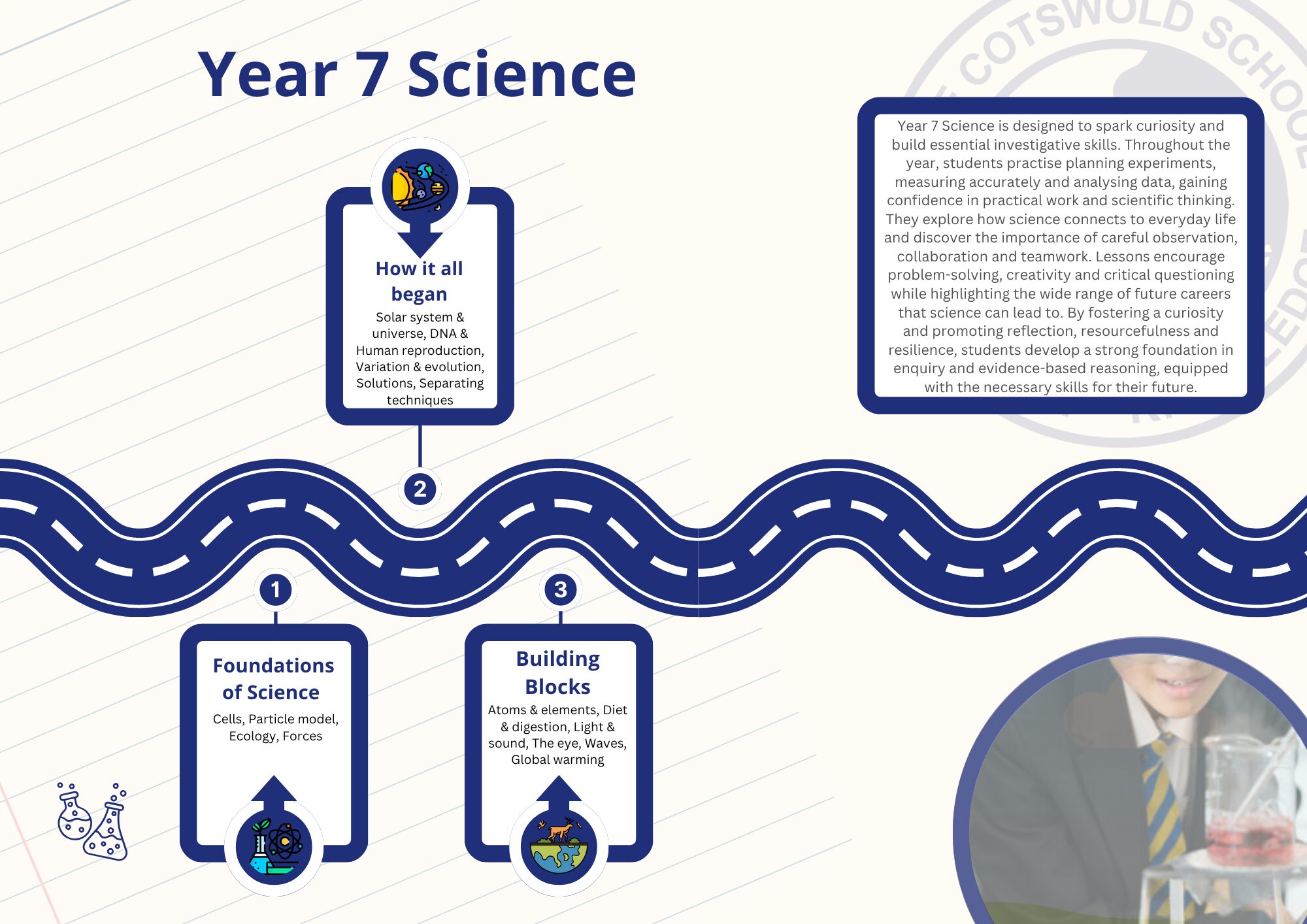

Key Stage 3 Curriculum Map
(click here for more information)
| Autumn term | Spring term | Summer term | |
|---|---|---|---|
|
| ||
| Year 8 | From the Sun to the Screen
| Sports Science
| Green Planet
|
Resources
Biology Paper 1 Learning Pathway – Combined Science
Biology Paper 2 Learning Pathway – Combined Science
Biology Paper 2 Learning Pathway – Triple Science
Chemistry Paper 1 Learning Pathway
Chemistry Paper 2 Learning Pathway
Physics Paper 1 Learning Pathway – Combined Science
Physics Paper 2 Learning Pathway – Combined Science
Physics Paper 1 Learning Pathway
